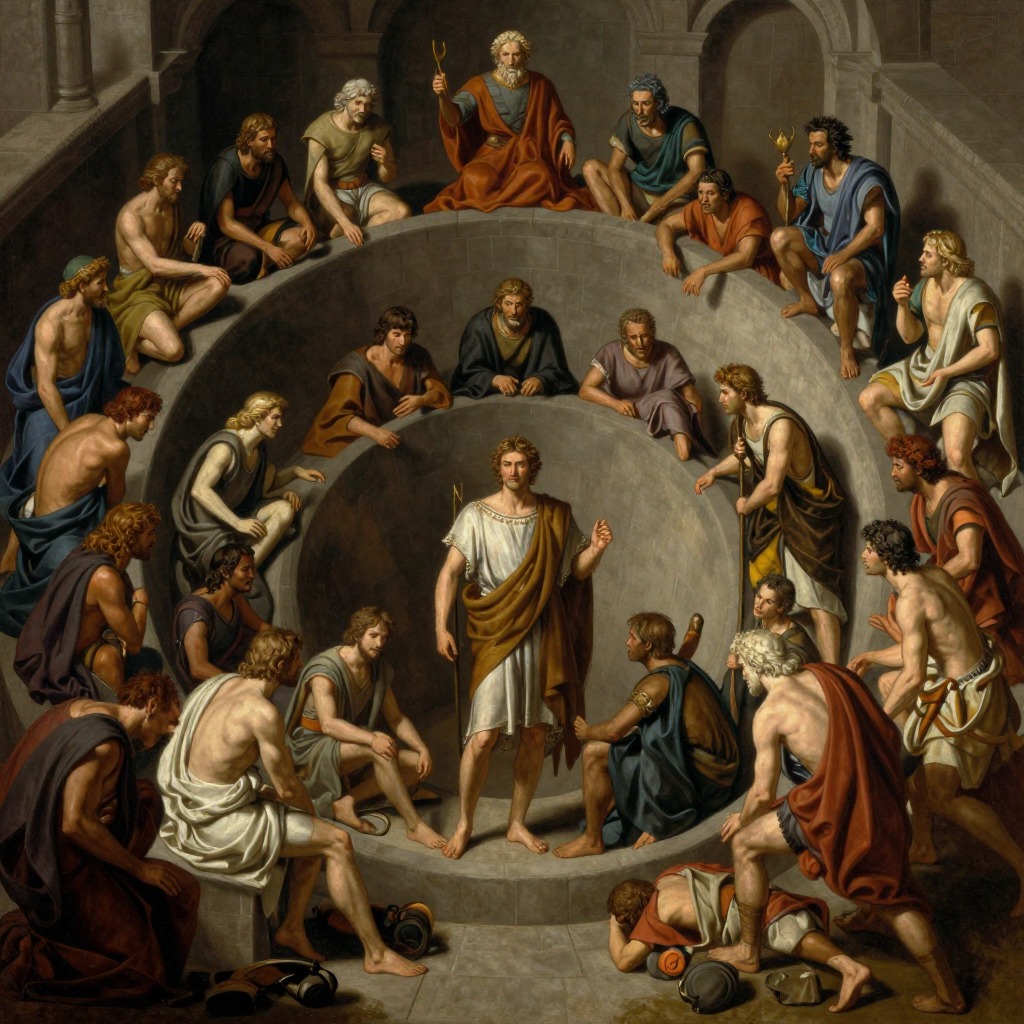
The Noble Castle
The Noble Castle is a luminous, walled fortress within Limbo, the first circle of Hell, where the great poets, philosophers, and virtuous pagans of antiquity dwell in a state of dignified but hopeless desire. It represents the highest honor human reason and virtue can achieve without Christian faith, serving as a poignant emblem of the limits of pre-Christian wisdom and the tragedy of unredeemed excellence.
Location and Description
The Noble Castle is situated in Limbo, the first circle of Hell, which houses the souls of the unbaptized and virtuous pagans who lived before Christianity or without faith. This circle is characterized not by physical torment but by "sorrow without torment" , a state of eternal sighing and unfulfilled desire. Within this somber expanse, a fire overcomes a hemisphere of darkness (E00693-E00694), illuminating the castle and its inhabitants. The castle itself is a noble structure, seven times encompassed with lofty walls and defended by a fair rivulet , which Dante and Virgil cross as if it were firm ground . They enter through seven portals , accompanied by the four great poets—Homer, Horace, Ovid, and Lucan—who have welcomed Dante into their company (E00719-E00727). Inside, they come into a meadow of fresh verdure , where the inhabitants are described as having "solemn eyes and slow, of great authority in their countenance; they spake but seldom, and with gentle voices" (E00737-E00739).
Inhabitants
The castle's meadow is populated by the "mighty spirits" of antiquity, whose presence exalts Dante (E00744-E00745). The poet sees a vast assembly of figures from classical history and myth: Electra with many companions, Hector, Aeneas, Caesar in armor with "gerfalcon eyes" (E00746-E00748); Camilla, Penthesilea, King Latinus with his daughter Lavinia (E00749-E00751); Brutus who drove out Tarquin, Lucretia, Julia, Marcia, and Cornelia (E00752-E00753); and "alone, apart, the Saladin" . The central figure is Aristotle, "the Master of those who know," seated with his philosophic family, including Socrates and Plato before him, and a host of other thinkers: Democritus, Diogenes, Anaxagoras, Thales, Zeno, Empedocles, Heraclitus, Dioscorides, Orpheus, Cicero, Livy, Seneca, Euclid, Ptolemy, Galen, Hippocrates, Avicenna, and Averroes (E00755-E00769). These souls, though unbaptized, are honored for their wisdom and virtue, yet they remain in Limbo, cut off from the beatific vision.
Significance and Thematic Meaning
The Noble Castle embodies the highest achievement of human reason and moral virtue unaided by divine revelation. Its seven walls and seven portals may symbolize the seven liberal arts or the seven cardinal virtues, suggesting a complete, self-contained system of classical wisdom. The castle's inhabitants are not punished for active sin but for the "defect" of not having faith , living "without hope in desire" . This creates a profound tension: the castle is a place of honor and dignity, yet it is also a prison of eternal longing. The presence of the Saladin, a Muslim ruler, and the virtuous pagans underscores the poem's engagement with the fate of the righteous non-Christian. The castle thus serves as a powerful symbol of the limits of human philosophy and the necessity of Christian faith for salvation, a theme that resonates throughout the entire Divine Comedy. It is a vision of what is lost—a golden age of wisdom and virtue that, however admirable, cannot attain the ultimate good. The castle's luminous isolation within the darkness of Hell makes it one of the most poignant and intellectually rich images in the Inferno, a testament to Dante's synthesis of classical and Christian thought.